What Is Gua Sha & Cupping Massage — And Why We Added It to the Menu
Some tension doesn’t respond to pressure. The areas that have been holding for years — the neck that never fully releases, the shoulders that are back up by Tuesday — sometimes need a different kind of conversation. Gua sha and cupping offer that. They’re not new ideas; they’re ancient techniques with a long track record and real research behind them. And they work differently than hands-on massage in ways that matter.
An Ancient Practice with Modern Research Behind It
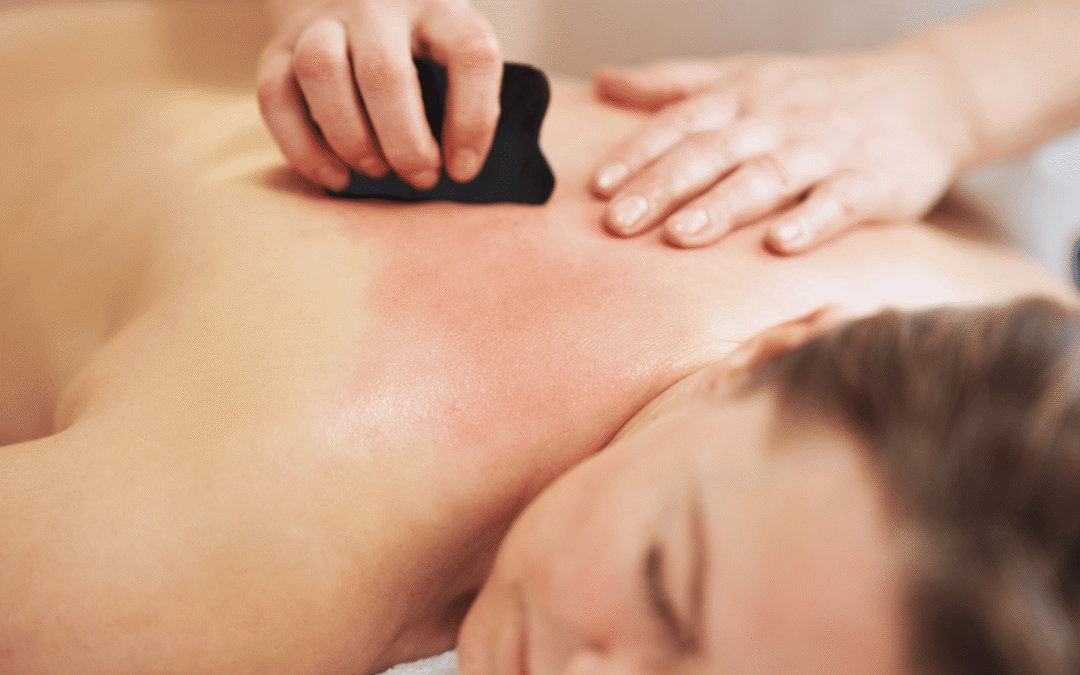
Gua sha has been used throughout Asia for centuries as a hands-on treatment for pain, tension, and restricted movement. The technique uses smooth, repeated strokes across the skin to move stagnant circulation, release connective tissue restriction, and relieve the tissue underneath. Research has shown it can produce a significant increase in microcirculation of surface tissue and may help reduce inflammation — results that are measurable, not just felt.
Cupping works differently but toward similar goals. Rather than pressing into tissue, it lifts — creating gentle suction that encourages movement and circulation in areas of chronic holding. Both stationary placement and gliding strokes are used, and active or passive movement may be incorporated to create freer function in treated areas. Massage is woven throughout the session to relax and integrate the work — so this is a full therapeutic experience, not just tool work from start to finish.
About the Redness
Both gua sha and cupping may leave temporary redness or flushing in treated areas. This is a normal circulation response — not bruising — and should dissipate relatively quickly, depending on your individual circulatory process. We want you to know this before you arrive, not discover it on your way out.
The relief, for most people, outlasts the redness by a significant margin.
Why We Added It to the Menu
Gua sha and cupping allow our therapists to address areas of chronic holding — neck, shoulders, upper back, hips — with precision and intention that goes beyond what hands-on pressure alone can reach. The tools work with the connective tissue differently, accessing restriction and stagnation in ways that conventional massage techniques sometimes can’t.
For clients, it means access to genuinely therapeutic work through a different kind of approach — one that many people find more tolerable than deep tissue pressure, and equally effective. But to be clear: this is therapeutic work, not a relaxation massage. It’s an alternative to deep tissue — not a lighter version of it.
Is This the Right Treatment for You?
It’s worth considering if you carry chronic tension that doesn’t fully release with conventional massage, if you want real therapeutic results through a different kind of approach, or if you’re simply curious about techniques with a long history of documented use.
It may not be the right fit if you have certain skin conditions, are on blood thinners, or prefer no visible after-effects. Your therapist will check in with you at the start of your session and adjust accordingly.
After Your Session
Keep treated areas out of direct sun, wind, and cold until any redness fades. Drink water. Give your body time to integrate the work.
Therapeutic Gua Sha & Cupping with Barbara is available in 60, 75, or 90-minute sessions. [Book here.]